
Environmental Product Declaration System
What is an EPD ?

An Environmental Product Declaration (EPD) is a standardized, third-party verified document that transparently reports a product’s environmental impacts across its full life cycle. It is based on a Life Cycle Assessment (LCA) methodology.
An EPD is issued by an organization to disclose the environmental performance of a product throughout its entire life cycle. This includes raw material extraction, transportation, manufacturing, distribution, use phase, and end-of-life management including reuse and recycling.
The declaration provides transparent and third-party verified environmental data, enabling fair comparison between products with the same function due to its standardized format.
The International Green Mark (IGM) develops EPDs for construction products in compliance with ISO 14025 and Product Category Rules (PCR) EN 15804, with the background LCA study based on ISO 14040 and ISO 14044.
Why invest in an EPD?
Future-proof your product
Gain advantage over competitors
Use for green building certification schemes
Benchmark your product’s environmental footprint
Sustainable supply chain management
Market your commitment to sustainability
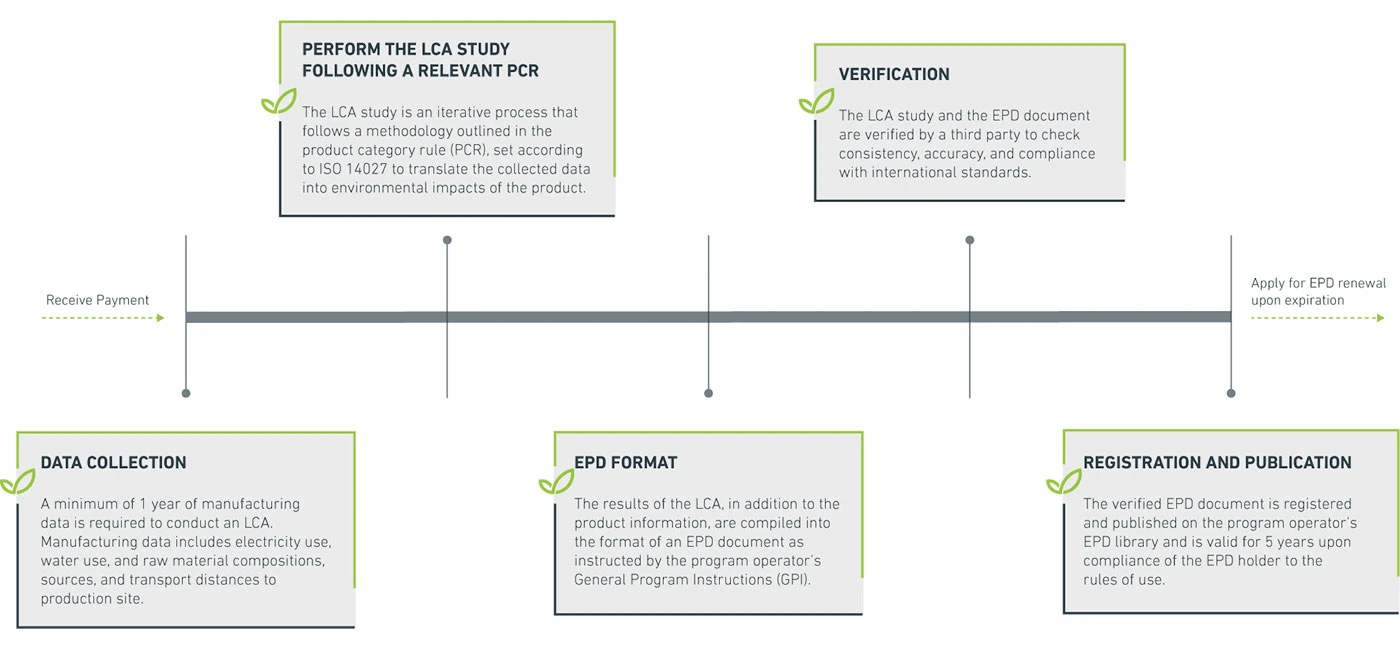
Process of obtaining an EPD
Mutual recognition agreements
To increase harmonization and comparability of EPDs, IGM collaborates with peer program operators through Mutual Recognition Agreements (MRAs). These are established after a detailed review of both systems to assess alignment in guidelines and procedures. A Memorandum of Understanding (MoU) is typically signed first to initiate cooperation.
The MRA allows EPDs registered under IGM to display the peer program’s logo, and vice versa, for an additional fee. Dual-registered EPDs are listed on both IGM and the respective organization’s website, allowing published EPDs to gain acceptance in a wider international market.
For MRA inquiries, contact igm@gord.qa.
Current Cooperations
The International EPD System
MoU